Starting with AI can feel overwhelming for many businesses. If you’re looking to start with AI without risk, it’s important to take a structured and practical approach. With so many tools and possibilities, it’s easy to overthink where to begin. Many organizations hesitate because they’re unsure where AI will actually deliver value, or they worry about investing in the wrong tools. Without a clear starting point, AI can feel complex and risky. The reality is that the companies seeing results today are not doing everything at once. They are starting small, testing quickly, and measuring what works.
This guide walks through a simple, practical framework to help you start using AI without unnecessary risk.
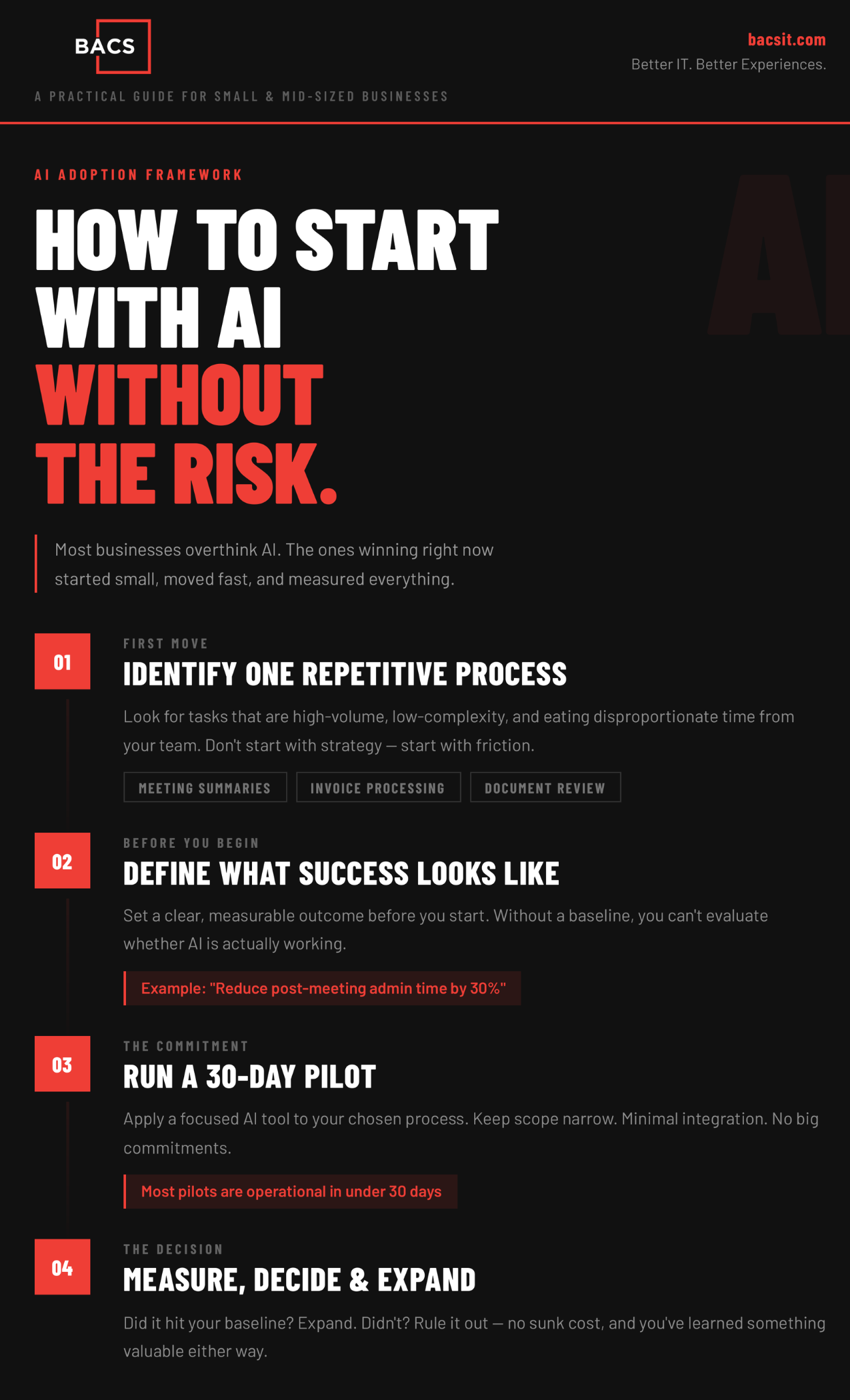
A simple framework for businesses to start with AI without risk by testing, measuring, and scaling effectively.
How to Start with AI Without Risk by Identifying One Process
The best place to start with AI is not strategy, it’s friction.
Look for tasks that are:
- high volume
- repetitive
- time consuming
Examples include meeting summaries, invoice processing, and document review.
By focusing on a single process, you reduce complexity and make it easier to test results. Starting small allows you to experiment without disrupting your operations and helps your team build confidence in how AI can be applied effectively.
Define What Success Looks Like
Before implementing any AI tool, define a clear outcome. Without a baseline, it becomes difficult to measure whether AI is actually delivering value. For example, reducing post-meeting administrative time by 30 percent is a measurable and meaningful goal.
Defining success also ensures alignment across your team. Everyone understands what outcome you are working toward, which makes it easier to evaluate results and justify further investment.
Run a 30-Day AI Pilot
Instead of committing to a full rollout, start with a focused pilot. Choose one tool and apply it to your selected process. Keep the scope small and avoid complex integrations at this stage.
Most AI pilots can deliver results within 30 days when properly scoped. This approach reduces risk and allows your business to experiment without long-term commitments. It also helps uncover practical insights about how AI fits into your existing workflows.
Measure, Decide, and Expand
After your pilot, evaluate the results. If the AI solution meets or exceeds your expectations, expand it into other workflows. If not, move on without significant cost or disruption.
This step is where many businesses gain the most value. Even if a pilot does not succeed, the insights gained can guide better decisions moving forward and prevent larger, more costly mistakes.
Why Businesses Struggle to Start with AI
Many businesses struggle to start with AI because they focus on tools before identifying the right use cases. Others attempt to implement AI across multiple areas at once, which increases complexity and risk. In some cases, organizations delay adoption entirely because they are waiting for a perfect strategy or complete certainty. This often leads to missed opportunities while competitors begin experimenting and learning.
By following a structured, step-by-step approach, businesses can reduce uncertainty and begin seeing results faster without taking on unnecessary risk.
How AI Consulting Services Support Implementation
While this framework provides a strong starting point, many businesses benefit from guidance when selecting tools, defining use cases, and implementing AI effectively. AI consulting services help organizations move faster by identifying high-impact opportunities, avoiding common pitfalls, and aligning AI initiatives with real business goals.
Working with experienced advisors can accelerate results and ensure that your investment in AI leads to measurable outcomes.
Not Sure Where to Start with AI?
If you’re exploring AI but unsure what makes sense for your business, start with our AI Readiness Assessment. It helps identify where AI can deliver the most value based on your workflows, tools, and goals, and provides clear, practical recommendations you can act on right away.