AI readiness is becoming a critical priority for organizations adopting artificial intelligence across daily operations. The challenge is no longer whether AI matters, but how to use it in a way that is secure, consistent, and aligned with real business workflows.
As AI adoption has moved from curiosity to operational use, several patterns have become clear. The organizations seeing the most success are not simply choosing the right tools. They are focusing on readiness across people, process, governance, and data.
These lessons are not about hype or model comparisons. They are about what organizations learn when AI becomes part of actual business operations. If your organization is early in this journey and wants a practical starting point, our AI Readiness Assessment helps identify where to focus first.
The First AI Readiness Lesson Most Organizations Learn
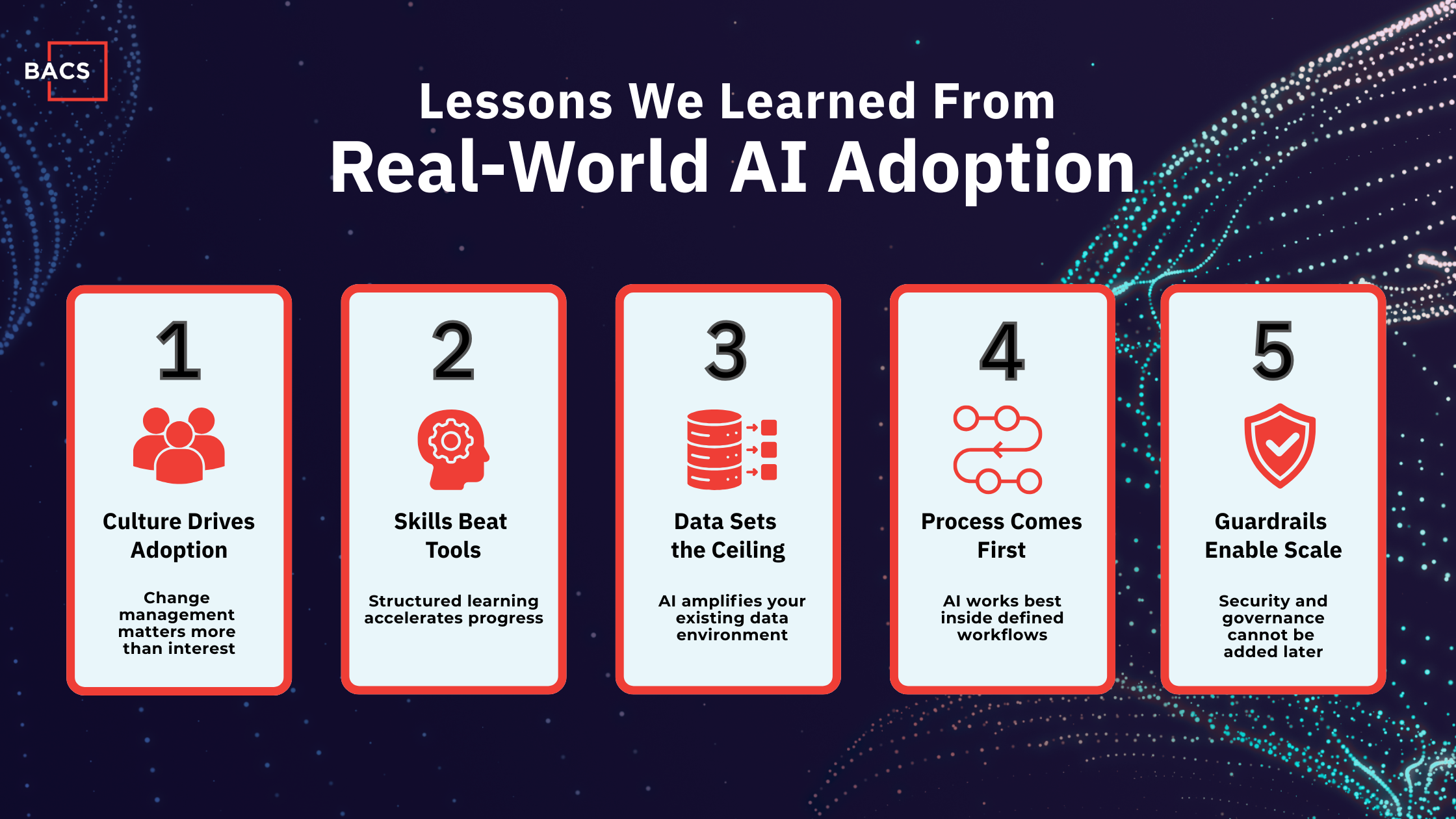
AI Readiness Starts With Culture and Change Management
AI adoption rarely fails because people are uninterested. More often, it fails because the rollout assumes people will simply figure it out.
Teams need clarity on what AI is for, what it is not for, and where human accountability still applies. Adoption improves when organizations explain why AI is being introduced, provide training by role, and identify internal champions who help normalize safe experimentation across teams.
Skills Matter More Than Tools
There is a learning curve, and structure accelerates progress
AI is not a plug and play upgrade. Even strong teams face a real learning curve.
The organizations that move fastest treat AI as a skill that improves with use. They encourage experimentation but also set standards so results stay consistent and repeatable. This balance helps teams learn without creating chaos.
For organizations evaluating specific platforms, our AI consulting services provide implementation and adoption guidance across tools like Copilot, Claude, Gemini, Perplexity, and ChatGPT, helping teams move beyond tool selection and into sustainable usage.
Data Is the Foundation
AI amplifies whatever data environment you already have
AI does not fix messy data. It exposes it.
When documents are inconsistent, sources are unclear, or ownership is fragmented, AI outputs become unreliable and adoption slows. This is why data quality and governance are core elements of AI readiness, not optional steps.
If you want a practical entry point, our post How to Start with AI Without Risk outlines a structured pilot approach that prioritizes control and learning before scale.
AI Must Align With Business Process
The deep work is usually process clarity
Many organizations try to layer AI on top of workflows that are already unclear. That usually creates more noise rather than better outcomes.
AI works best when it supports a defined process with clear inputs, clear decision points, and clear owners. In many cases, the most valuable part of AI readiness work is mapping how work actually happens today, then deciding where AI can responsibly add support.
For a broader view of how we approach this work, see Artificial Intelligence Consulting at BACS.
AI Readiness Requires Security and Governance
Trust and guardrails enable scale
As AI becomes more embedded in daily operations, risk enters the picture whether you plan for it or not.
Organizations need clear boundaries around data handling, permissions, and acceptable use. Without guardrails, adoption either becomes risky and inconsistent or so restricted that it never delivers value.
If you are developing internal guidance and want a plain language starting point, our blog – Does Your Organization Have An Employee AI Policy? is a helpful reference. Organizations developing governance structures may also benefit from reviewing the NIST AI Risk Management Framework.
What AI Readiness Actually Means
Most organizations do not need more AI tools. They need clarity in five areas:
- People and adoption, how change is managed
- Skills and enablement, how teams learn safe usage
- Data readiness, quality, structure, access, and ownership
- Process alignment, how AI fits real workflows
- Security and compliance, how risk is addressed from day one
These are the areas we evaluate in our AI Readiness Assessment so teams can focus on what will actually unblock progress.
How BACS Helps
BACS helps organizations move from interest to operational use with a practical, readiness‑first approach.
Depending on where you are starting, that support may include AI readiness assessments with prioritized roadmaps, use case selection focused on operational impact, process review and workflow design, enablement and training for consistent adoption, and governance guidance to ensure AI usage remains secure and compliant.
Learn more about our approach on the AI Consulting page.
Who This Is For
This is a good fit for organizations that are seeing AI appear across teams and want consistency, need a safe entry point that avoids hype, want AI aligned to real processes rather than isolated experiments, or have security and compliance concerns that must be addressed early.
If that sounds familiar, a conversation with BACS is a practical next step. We can help you understand where you are today and what needs to come next.